

When you look in the mirror and notice subtle changes, wrinkles are usually the first thing you blame. It could be that your cheeks look a little less full, your jawline seems a bit less sharp, or you look tired in ways that you just can’t put your finger on. While fine lines play a role in what you’re seeing, they don’t tell the entire story.
Facial aging is actually a complicated process. It happens beneath the surface as your skin, natural fat pads, and structural support shift over time. Understanding the causes of these changes is important if you want to address them with aesthetic treatments. Fortunately, there are ways you can skip surface-level fixes to target the root causes and restore a refreshed, natural, and vibrant look.
Key Takeaways
- Facial aging is not just about wrinkles: Facial aging is driven by deep structural shifts, including collagen loss, shifting fat pads, and subtle changes in facial support over time.
- Causes of facial aging: The main causes of facial aging include a natural slowdown in collagen production starting in your mid-to-late twenties, accelerated by everyday factors like sun exposure, stress, and lifestyle.
- The “Triangle of Youth” Inversion: As volume diminishes, fullness shifts from the upper face (cheeks and temples) downward to the lower face and jawline, creating a heavier profile.
- Treating the Source, Not Just the Symptom: Some treatments can help rebuild the underlying support rather than just smoothing the surface. These
How Facial Aging Works
If facial aging were just about skin getting older, surface creams would solve everything. But your face is built on a multi-layer foundation of skin, collagen, supportive fat pads, and bone structure. These elements act as scaffolding, creating the structure and shape of your face.
As we age, a few simultaneous biological changes happen, such as:
- Collagen & Elastin Production Slow Down: These crucial proteins keep your skin firm and springy. Beginning in your twenties, your body naturally produces less collagen each year, and the quality of what it produces declines.
- Fat Pads Shift and Shrink: The youthful fat pads that give your cheeks high, plump contours begin to thin out and gradually slide downward.
- Environmental Stress Accelerates Damage: Sun exposure, daily stress, sleep quality, and environmental pollutants deplete your skin’s natural resilience and break down existing collagen more quickly.
Together, these changes lead to common frustrations like hollow cheeks, thinning lips, sagging skin, and an overall tired expression even when you’re fully rested and feeling great.
What Is Collagen and Why Do We Lose It?
Collagen is the most abundant protein in the body, accounting for roughly 30% of our body’s total protein. It serves as one of the primary building blocks of healthy skin, providing the structure, strength, and support that helps skin remain firm and youthful.
Beginning in our mid-to-late twenties, collagen production naturally declines. Most experts estimate that adults lose approximately 1% of their collagen each year after age 25 to 30. For women, this process often accelerates during and after menopause due to natural hormonal shifts.
While declining collagen is an inevitable part of aging, certain habits and environmental stressors can accelerate its depletion.
Factors That Accelerate Collagen Loss
- Sun Exposure & UV Damage: Ultraviolet rays break down collagen fibers and damage elastin in the skin.
- Chronic Stress & Lack of Sleep: High cortisol levels and poor rest interfere with the skin’s natural nightly repair cycles.
- Poor Nutrition & Environmental Pollutants: Diets lacking in key nutrients or heavy exposure to airborne toxins increase oxidative stress.
- Repetitive Facial Expressions & Lifestyle Habits: Habits like smoking and repetitive muscle movements contribute to accelerated breakdown over time.
The Shape of Aging: The Triangle of Youth Inversion
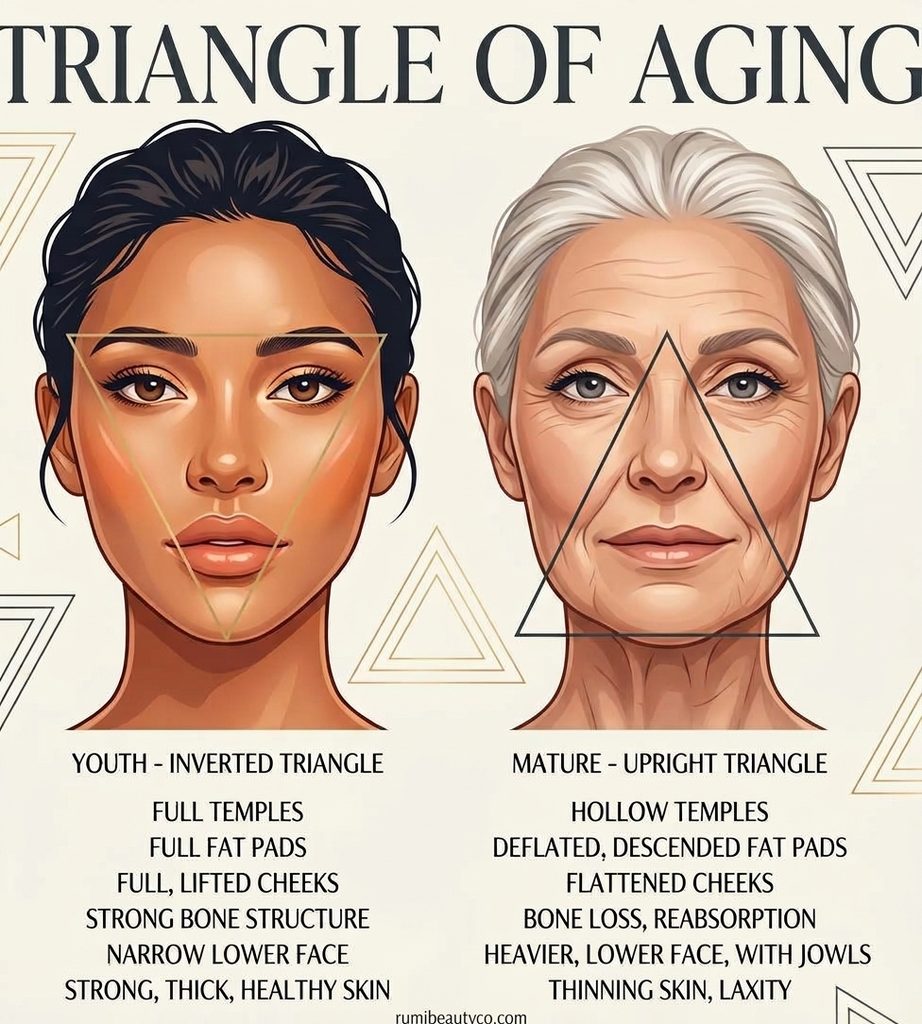
Have you ever wondered why a face looks different in photographs over time? It often comes down to overall shape and shadow distribution.
A youthful face naturally resembles an upside-down triangle: wide, high cheekbones that taper smoothly down to a defined chin and sculpted jawline. This is popularly called the “triangle of youth”
Over time, as structural volume and collagen diminish, that triangle flips right-side up:
- The temples and midface lose their fullness, resulting in a sunken or flat appearance.
- Shadows appear beneath the eyes and around the mouth (causing deeper nasolabial folds and marionette lines).
- Volume pools along the lower face and jawline, leading to softened definition and early jowls.
Often called the “triangle of aging”, this downward structural shift is usually what makes us look “older,” and it can happen long before deep wrinkles ever show up.
Where Does Facial Volume Loss Show First?
Collagen is distributed throughout the body, including the entire face. That means facial aging impacts the entire face rather than just specific areas. Signs of volume loss do tend to appear earlier in some areas, however.
Temples
Volume loss in the upper face creates a hollowed appearance that narrows the temples and can disrupt overall facial balance. If this loss is significant, it can make you look much older than you are.
Under-Eye Area
Delicate under-eye skin combined with volume loss creates shadows, hollows, and a persistent tired look, no matter how much sleep you got. If you always need concealer, it is likely due to volume loss rather than exhaustion.
Cheeks & Midface
Midface flattening is one of the most common signs of aging, as it removes the structural scaffolding that supports your lower facial features. This volume loss removes the “plump” shape often associated with youth.
Around the Mouth & Jawline
Collagen loss around the mouth contributes to fine lines, marionette lines, and thinner lips, while a softening jawline leads to jowls and a less sculpted profile. Habits like smoking impact this area, making you look older.
Restoring Volume and Supporting Collagen
You can’t use neurotoxins alone to address facial aging because they only target the surface. Facial aging occurs across multiple layers, so the most effective treatment plans address the underlying root causes. Fortunately, there are many treatments you can use to :
- Biostimulators: Rather than just adding volume, products like Sculptra and Radiesse work beneath the surface to stimulate your body’s natural collagen production. This gradually restores structural support, making you look more youthful.
- Dermal Fillers: Dermal fillers like Juvéderm and Restylane instantly replenish lost volume in the cheeks, lips, and hollow areas. While they don’t trigger your body’s collagen production, they do provide immediate volume to balance and contour.
- Thread Lifts: Thread lifts are designed to lift sagging tissue and sculpt the jawline without invasive surgery. These are often combined with additional treatments for an even more dramatic transformation, such as the Rumi Lift, which combines PDO threads, neurotoxins, and dermal fillers.
- Microneedling & Skin Renewal: Microneedling with PRF or exosomes kickstarts cell turnover to tighten skin laxity, refine texture, and enhance skin quality. This often requires several sessions, but provides long-lasting results since it triggers your body’s natural healing responses.
Schedule Your Personal Consultation
If you’re ready to explore customized solutions for facial volume loss and discover a refreshed, natural look, we’d love to guide you. We’ll be happy to answer your questions and help you find the best treatment path for you.
Visit us in Chino, CA, book your consultation online, or call us at (909) 218-3993 to take the first step!
