

Crepey skin on the neck and chest is characterized by thin, fragile, and finely wrinkled skin that resembles crepe paper. This type of skin can affect larger surface areas and is often accompanied by a loss of elasticity, sagging, and a noticeable drop in hydration. This is why you often see it on your arms, your hands, under your eyes, and on your neck and chest.
Reversing and preventing crepey skin requires a combination of targeted topical care, daily protective measures, and professional biostimulatory treatments. Let’s talk about what causes crepey skin on the neck and chest and what you can do about it.
What Causes Crepey Skin on the Neck and Chest?
The skin on the neck and décolletage areas is delicate and significantly thinner than facial skin and possesses fewer oil glands. This makes it especially vulnerable to structural breakdown. This is why it is so common to see fine wrinkles in these areas.
Crepey skin is primarily caused by the depletion of collagen and elastin. These are the structural proteins responsible for keeping skin firm, smooth, and resilient. While these elements start to break down naturally as we start to age, environmental exposure and lifestyle factors accelerate this process significantly.
- Sun Damage (Photoaging): Ultraviolet (UV) radiation from sunlight breaks down collagen and elastin fibers in the dermis. Because the chest and neck are frequently exposed to sun without adequate protection, they show signs of photoaging earlier than other regions of the body.
- Natural Loss of Elastin and Collagen: Beginning in the mid-to-late 20s, natural collagen production decreases by approximately 1% each year. Hormonal shifts during perimenopause and menopause further accelerate collagen loss, causing skin to thin and lose its underlying support structure.
- Lack of Moisture and Sebum: The neck and chest contain far fewer sebaceous (oil) glands than the face. As skin ages, its natural moisture barrier weakens, leading to chronic dryness that accentuates fine, paper-like crinkling.
- Repetitive Movement and Sleep Posture: Side sleeping creates deep vertical creases across the chest (décolletage), while looking down at phones or screens (“tech neck”) creates persistent horizontal lines across the neck. Over time, these temporary folds turn into permanent surface crepiness.
- Lifestyle and Environmental Stressors: Smoking, pollution, rapid weight fluctuations, and poor nutrition generate free radicals that damage skin cells and impair the body’s ability to repair collagen.
Ingredients that Can Treat Crepey Skin
Crepey skin is a natural part of aging, and while you may not be able to completely avoid it, you can do many things to significantly improve it. Your skincare routine can also slow down these types of problems.
To visibly improve crepey skin, topical formulas must focus on three primary functions: stimulating new collagen production, reinforcing the skin’s moisture barrier, and protecting against ongoing oxidative damage.
1. Retinol
Retinoids remain the benchmark for repairing structural skin aging. They accelerate cellular turnover and stimulate fibroblasts to synthesize new collagen. For the sensitive neck and chest, gentler derivatives like encapsulated retinol, retinaldehyde, or plant-based bakuchiol are preferred to prevent redness and irritation while still delivering firming benefits. You usually need to start slowly with retinol, using it once or twice a week until you can use it more often without redness.
2. Hydrating and Barrier-Repairing Ingredients
Adding moisture and restoring the skin’s barrier is vital in improving crepey skin. The following ingredients are known to improve your skin’s ability to maintain moisture.
- Hyaluronic Acid: Attracts up to 1,000 times its weight in water, immediately plumping up fine surface crinkling and filling out thin skin.
- Ceramides and Fatty Acids: Lock in moisture and repair the lipid barrier, preventing transepidermal water loss (TEWL) that makes crepey skin look more pronounced.
- Glycerin: A classic humectant that draws moisture into the outer layers of the skin, maintaining smooth texture throughout the day.
3. Peptides and Growth Factors
Signal peptides (such as palmitoyl tripeptide-5) send signals to skin cells to manufacture more collagen and elastin, helping to rebuild skin density over time. Growth factors assist in cellular repair, improving overall skin thickness and resilience on delicate areas.
4. Antioxidants
Antioxidants help protect your body against free radicals by neutralizing them.
- Vitamin C (L-Ascorbic Acid or Tetrahexyldecyl Ascorbate): Vitamin C neutralizes free radicals from UV light and pollution, brightens sunspots, and acts as a necessary cofactor in collagen synthesis.
- Niacinamide (Vitamin B3): Calms inflammation, reduces hyperpigmentation on the chest, and strengthens the skin barrier.
Daily Skincare Routine for Firming the Neck and Chest
To have a real impact, you’ll need to be consistent. And remember, it’s important that you use proper application techniques to avoid stretching or tugging this thin, delicate skin.
If you’re unsure how to put together a skincare routine for your neck and chest, this chart can help.
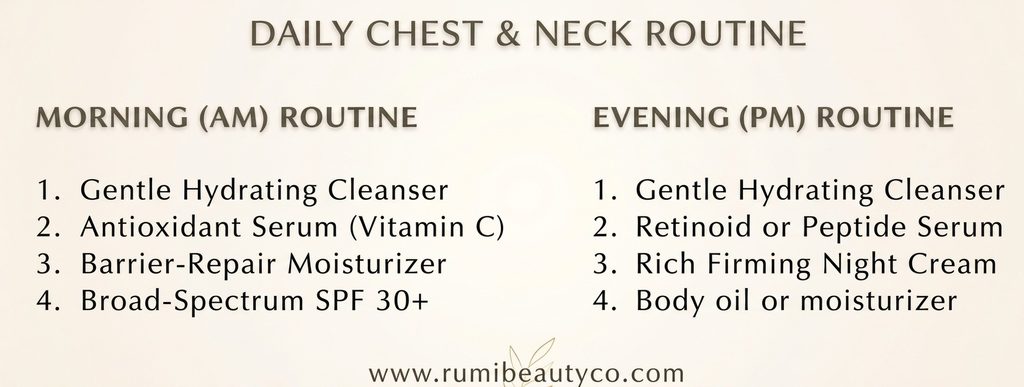
Morning Routine: Protect and Hydrate
- Cleanse: Wash with a mild, sulfate-free hydrating cleanser. Avoid harsh scrubs that disrupt the skin barrier.
- Target: Apply an antioxidant serum containing Vitamin C or niacinamide across the neck and chest to defend against daily environmental stressors.
- Moisturize: Apply a hydrating cream rich in hyaluronic acid and ceramides to plump the surface.
- Protect: Finish with a broad-spectrum mineral or chemical sunscreen with SPF 30 or higher. Extend coverage from the jawline down to the bottom of the décolletage.
Evening Routine: Repair and Rebuild
- Cleanse: Remove sunblock, oil, and daily impurities using a gentle cleanser.
- Treat: Apply a specialized neck/chest serum or a low-strength retinol 2–3 nights a week, gradually increasing frequency as tolerated. On alternate nights, use a peptide-rich serum to support repair without irritation.
- Nourish: Layer a rich, restorative moisturizer or dedicated neck cream designed to lock in active ingredients overnight.
Proper Application Technique
Always apply products using gentle, upward strokes starting at the base of the chest and moving up toward the jawline. Never pull or drag downward, as this pulls on delicate, lax skin.
Lifestyle Modifications to Prevent Crepey Skin
Topical treatments work best when paired with proactive daily habits that prevent further tissue degradation.
- Apply Sunscreen Daily: Sun damage is responsible for up to 80% of visible skin aging. Reapply SPF to the chest and neck every two hours when outdoors.
- Adjust Sleep Posture: Sleeping on your back prevents the skin on your chest from folding together for hours at a time. Special chest pads or contoured sleep pillows can also reduce friction and creasing for side sleepers.
- Maintain Ergonomic Screen Positions: Elevate phones, tablets, and computer monitors to eye level to reduce repetitive downward bending of the neck.
- Hydrate Internal Tissues: Drink plenty of water throughout the day to support overall cellular hydration and skin turgor.
- Avoid Harsh Body Soaps and Hot Water: Long, hot showers and heavily fragranced body washes strip natural lipids from the skin. Use lukewarm water and gentle, fragrance-free body washes.
Rebuilding Skin Architecture with Hyperdilute Radiesse
For crepey skin on the neck and chest, non-surgical biostimulatory treatments offer an advanced way to restore firm, healthy skin quality from within. Hyperdilute Radiesse is one of the most targeted professional treatments available for addressing thin, wrinkled, and lax tissue across broader, delicate body areas.
What Is Hyperdilute Radiesse and How Does It Work?
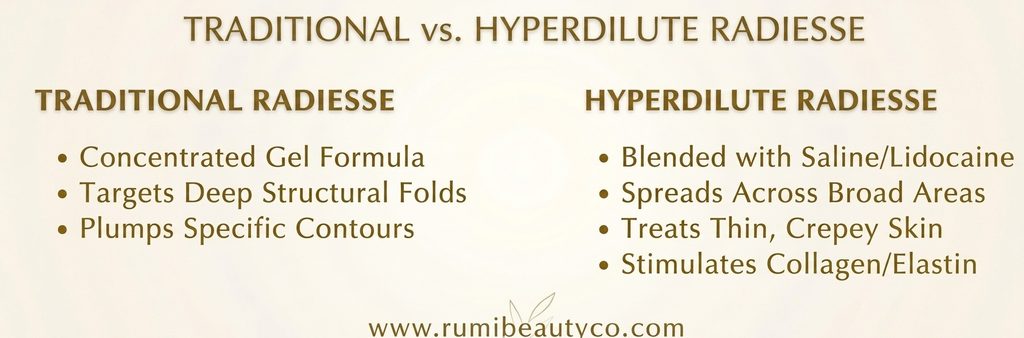
Radiesse is an injectable treatment composed of Calcium Hydroxylapatite (CaHA) microspheres suspended in a water-based gel carrier. In its traditional form, it is used as a thick dermal filler to add structural volume to deep facial contours, such as the cheekbones or jawline.
When used in a hyperdilute form, the provider mixes Radiesse with a precise ratio of sterile saline and local anesthetic (lidocaine). This dilution alters its function entirely: rather than acting as a volumizing filler, it becomes a smooth, highly spreadable regenerative solution. This lets the solution be more effectively injected superficially across the neck or chest.
Once injected, the CaHA microspheres act as a microscopic lattice that activates fibroblasts,the body’s natural collagen factories. This triggers new collagen type I and elastin synthesis, along with improved microcirculation, effectively thickening thin, papery skin without adding unwanted bulk or puffiness.
Why Hyperdilute Radiesse Is Ideal for the Neck and Décolletage
The skin on the neck and chest is delicate, thin, and prone to showing movement marks or superficial irregularities if traditional dermal fillers are used. Hyperdilute Radiesse provides several distinct advantages for these specific body regions:
- No Unnatural Bulk: Because the mixture is fluid, it diffuses evenly into the tissue, avoiding the over-plumped appearance of standard fillers.
- True Structural Repair: Rather than temporarily masking lines, it strengthens the dermal matrix itself, making skin noticeably thicker, firmer, and more resilient over time.
- Proven Safety and Approval: Radiesse is FDA-cleared for treating wrinkles on the décolletage, making it a reliable, high-performing choice for chest rejuvenation.
- Widespread Coverage: A single session can cover large surface areas across the entire neck and chest in a single, cohesive application.
Expected Timeline and Results
Because Hyperdilute Radiesse works by encouraging your body to build its own tissue, improvements appear gradually and look entirely natural.
- Immediate (Days 1–7): You may experience mild temporary swelling, redness, or slight pinpoint bruising, along with an immediate subtle hydration boost from the liquid carrier.
- Weeks 4–6: Initial collagen growth begins to take hold. You will start noticing early improvements in surface smoothness and skin turgor.
- Months 2–4: Peak visible results take effect as new collagen and elastin fibers mature. The skin appears visibly denser, tighter, and significantly less crepey.
- Longevity: Results typically last between 12 to 18 months or longer. Optimal results are often achieved with an initial series of 1 to 3 sessions spaced 4 to 6 weeks apart, followed by an annual touch-up to maintain skin thickness.
Complementary In-Clinic Treatments for Crepey Skin
While Hyperdilute Radiesse rebuilds deep structural collagen, combining it with complementary non-invasive treatments can address surface discoloration and fine texture changes on the neck and chest. You should consult with a provider to find the best option for you.
| Treatment Type | Primary Mechanism | Key Benefits for Neck & Chest |
| Hyperdilute Radiesse | CaHA microspheres stimulate deep fibroblast collagen and elastin production. | Rebuilds skin thickness, restores firmness, and smooths broad crepiness without volume. |
| RF Microneedling | Delivers radiofrequency energy into deeper dermal layers through insulated micro-needles. | Tightens moderate skin laxity and contracts deep tissue matrices. |
| Fractional / CoolPeel Lasers | Uses light energy to resurface damaged outer epidermal layers. | Erases sunspots, corrects sun-damaged pigmentation, and smooths fine surface crinkling. |
| Chemical Peels | Applies exfoliating acids (such as TCA or glycolic acid) to slough away dull skin cells. | Brightens skin tone, refines surface texture, and improves topical product absorption. |
Frequently Asked Questions
Clients at our Chino, California med spa often ask these questions about how to treat crepey skin and wrinkles on the neck and chest. If you have a question you don’t see, we encourage you to give us a call at (909) 218-3993 and we’ll be happy to answer it.
Can crepey skin on the neck and chest be completely reversed?
While completely reversing crepey skin to its original youthful state might not be entirely possible, you can dramatically improve its appearance. Combining consistent topical ingredients like retinoids and peptides with collagen-stimulating treatments like Hyperdilute Radiesse can restore significant firmness, density, and smoothness to the skin.
How is Hyperdilute Radiesse different from regular dermal fillers?
Regular dermal fillers are concentrated gels used to fill localized hollows or add volume to specific features like cheeks or lips. Hyperdilute Radiesse is thinned with saline and lidocaine, allowing it to spread across broad areas like the neck and chest to rebuild overall skin quality and thickness without adding mass or volume.
Is crepey skin the same as deep wrinkles?
No. Deep wrinkles are usually localized folds caused by repetitive muscle movement or structural volume loss (such as smile lines or forehead furrows). Crepey skin refers to a widespread textural change where the skin becomes thin, fragile, finely crinkled, and loose, affecting larger surface areas.
How long does it take to see results from Hyperdilute Radiesse?
Initial subtle plumping occurs right away from the fluid carrier, but structural changes build progressively over time. You will begin to see noticeable skin firming around 4 to 6 weeks post-treatment, with peak collagen remodeling and smoothing occurring between 2 to 4 months.
How many sessions of Hyperdilute Radiesse will I need?
Depending on the degree of skin laxity and thinning, most patients benefit from an initial series of 1 to 3 treatments spaced 4 to 6 weeks apart. Once the collagen matrix is rebuilt, results can last 12 to 18 months, with simple annual touch-up sessions to maintain overall skin density.